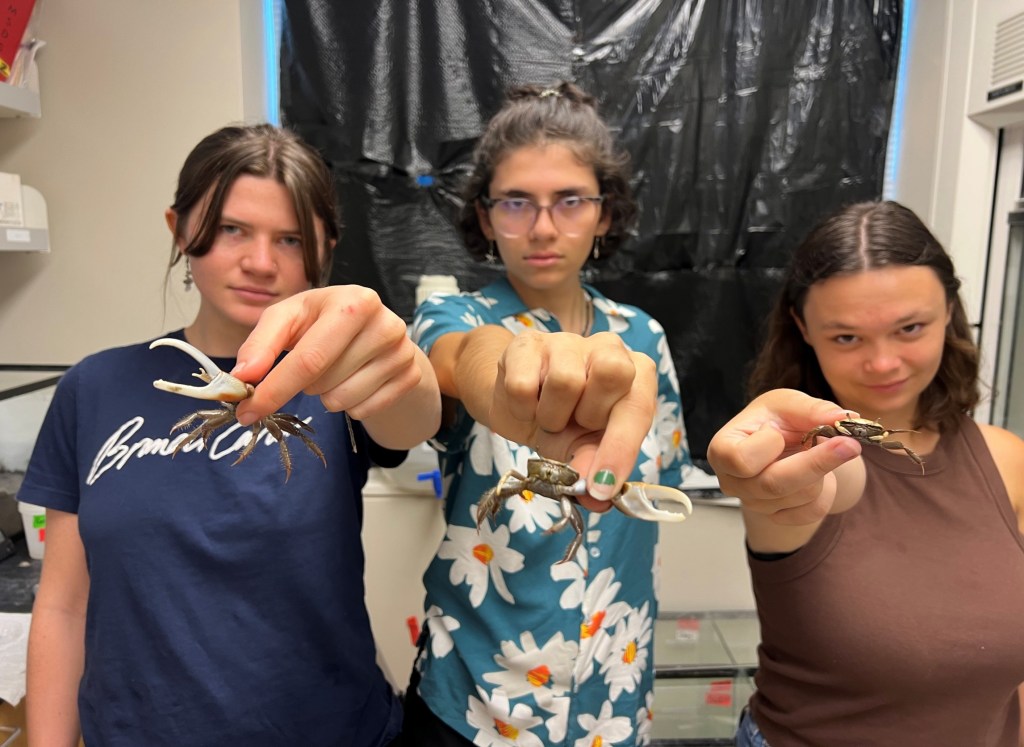
My lab is investigating how parasite-induced behavior changes in fiddler crabs (Minuca spp.) alter their ecological relationship with the marsh cordgrass (Spartina alterniflora).
In their native range, fiddler crabs have a facilitative relationship with marsh cordgrass, where fiddler crab burrowing promotes cordgrass above-ground biomass. However, the fiddler crabs that have expanded their range northward due to climate change are negatively associated with cordgrass above-ground biomass. Additionally, the crabs in the expanded range have a greatly reduced parasite burden than those found in the native range, and parasites often alter the behavior and activity levels of crustacean species.
We are investigating if this reduced parasite burden may change the burrowing activity of fiddler crabs and if this effect could be responsible for the observed change in the association between these keystone species. We are doing so by incorporating experimental data on fiddler crab behavior with mechanistic modeling to simulate cordgrass – fiddler crab – parasite dynamics on a landscape scale.
 Aquatic Disease Ecology in a Changing World