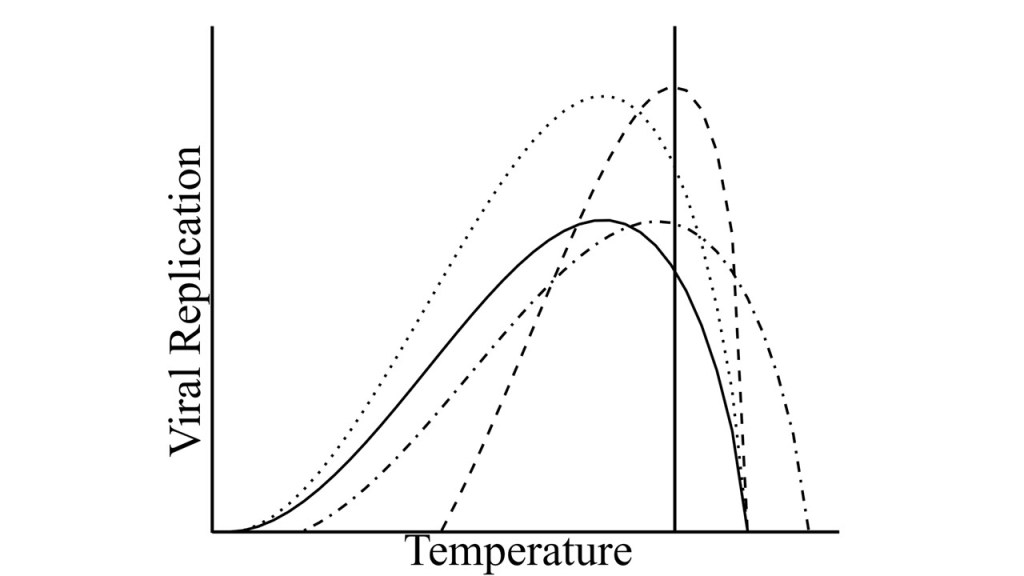
Current projections of how climate change will influence parasite impact on host species are primarily based on contemporary host-parasite relationships. This paradigm neglects the capacity of parasites, particularly micro-parasites like bacteria and viruses, to evolve to changing environmental and host conditions.
I am currently investigating how this capacity for adaptation may shift how IHNV interacts with its host, rainbow trout (Oncorhynchus mykiss), under warming. This virus demonstrated an ability to adapt to warmer temperatures when it entered the rainbow trout aquaculture industry in the 1960’s. To investigate this ability further, I have passaged one IHNV isolate through cell cultures at an optimal (15°C) and elevated (21°C) temperature, and after only five passages, the virus passaged at 21°C demonstrated an altered thermal performance curve from the original or 15°C passaged strains. Planned experiments involve passaging the virus in vitro and in vivo at different temperatures to understand how selection pressure of changing temperature regimes and the host immune system interact to shape phenological and genological changes to the virus.
 Aquatic Disease Ecology in a Changing World